
Navigating Australian shoe sizes from US measurements can be tricky, requiring understanding regional differences.
This guide simplifies conversions, ensuring a comfortable and accurate fit for every customer.
Understanding the Differences in Sizing Systems
Shoe sizing isn’t standardized globally; the US and Australia employ distinct systems, leading to potential confusion. The US system, while widely used, doesn’t align directly with Australian or European standards. Historically, sizing evolved organically, influenced by local manufacturing practices and foot measurement techniques. Australian sizing often mirrors the British system, creating a one-size difference when converting from US men’s sizes – subtract one.
However, women’s conversions are more complex, requiring careful attention to charts. European sizing introduces another layer of variation, with sizes differing incrementally. These discrepancies stem from differing methods of measuring foot length and width, as well as variations in last shapes (the foot-shaped form used in shoe construction). Understanding these nuances is crucial for accurate conversions and avoiding ill-fitting footwear.
Why Shoe Size Conversion is Necessary
Accurate shoe size conversion is paramount for online shopping, especially when purchasing from Australian retailers while residing in the US, or vice versa. Relying on familiar US sizes without conversion often results in receiving shoes that are either too large or too small, leading to discomfort and returns. This is particularly important given the increasing globalization of retail and the ease of international purchases.
Furthermore, different brands may have slight variations in sizing, even within the same country. Conversion charts provide a baseline, but understanding brand-specific guides is essential. Proper fit prevents foot problems like blisters, bunions, and pain, ensuring optimal foot health and comfort. A well-fitting shoe enhances performance during athletic activities and contributes to overall well-being.
Mens Shoe Size Conversion
Converting US men’s sizes to Australian requires subtracting one size; a US size 10 typically equates to an Australian men’s size 9 for a proper fit.
US to Australian Mens Shoe Size Chart
Below is a comprehensive chart detailing the conversion between US and Australian men’s shoe sizes. It’s crucial to remember that this serves as a general guideline, and variations can occur between brands. Always consult specific brand size charts when available for the most accurate fit. This chart incorporates common sizing equivalencies, assisting in selecting the correct shoe size when purchasing from Australian retailers or comparing sizes online.
| US Mens Size | Australian Mens Size |
|---|---|
| 6 | 5 |
| 6.5 | 5.5 |
| 7 | 6 |
| 7.5 | 6.5 |
| 8 | 7 |
| 8.5 | 7.5 |
| 9 | 8 |
| 9.5 | 8.5 |
| 10 | 9 |
| 10.5 | 9.5 |
| 11 | 10 |
| 11.5 | 10.5 |
| 12 | 11 |
Remember to always prioritize accurate foot measurement and brand-specific guides for optimal comfort.
Converting a Specific US Mens Size to Australian
To accurately convert a US men’s shoe size to Australian sizing, a simple rule generally applies: subtract one size from your US size. For instance, if you typically wear a US men’s size 10, you would likely need an Australian men’s size 9. However, this isn’t a universal rule, and discrepancies can occur due to brand-specific sizing variations. It’s always best practice to consult the individual brand’s size chart whenever possible.
Consider a US size 11.5; converting this would suggest an Australian size of 10.5. Always double-check, especially when purchasing online, as sizing can differ. Prioritize measuring your foot length and comparing it to the brand’s size guide for the most precise fit. Ignoring these nuances can lead to discomfort or an ill-fitting shoe.
Common Mistakes When Converting Mens Sizes
A frequent error is assuming a direct, one-to-one conversion between US and Australian men’s shoe sizes. While subtracting one size often works, it’s an oversimplification. Brand variations are significant; Gucci, Nike, and other manufacturers employ unique sizing standards. Relying solely on general charts can lead to incorrect fits.
Another mistake is neglecting width fittings. Australian shoes, like those elsewhere, offer varying widths. A US size 10 regular width might not equate to an Australian 9 regular width. Ignoring width can cause discomfort. Finally, failing to measure your feet accurately is a common pitfall. Foot size changes over time, and self-measurement is crucial for a precise conversion. Always prioritize accurate foot length and width measurements.
Womens Shoe Size Conversion
Converting US women’s sizes to Australian requires careful attention, as differences exist. Utilize conversion charts and consider brand-specific sizing for optimal results.
US to Australian Womens Shoe Size Chart
Below is a comprehensive chart detailing the conversion between US and Australian women’s shoe sizes. Please note that these are general guidelines, and variations can occur between brands. Always consult the specific brand’s size chart when available for the most accurate fit. This chart combines information from multiple sources to provide a reliable reference point.
| US Size | Australian Size |
|---|---|
| 5 | 4 |
| 5.5 | 4.5 |
| 6 | 5 |
| 6.5 | 5.5 |
| 7 | 6 |
| 7.5 | 6.5 |
| 8 | 7 |
| 8.5 | 7.5 |
| 9 | 8 |
| 9.5 | 8.5 |
| 10 | 9 |
| 10.5 | 9.5 |
| 11 | 10 |

Remember to always prioritize trying on shoes whenever possible, or carefully reviewing return policies when purchasing online. Foot shape and preferences can also influence the ideal size.
Converting a Specific US Womens Size to Australian
Let’s illustrate converting a US women’s shoe size to its Australian equivalent. If you typically wear a US size 7.5, the corresponding Australian size is generally 6.5. This conversion is based on the common practice of subtracting 1 from the US size to find the Australian size. However, it’s crucial to acknowledge that this isn’t a universal rule, and discrepancies can arise.
To ensure accuracy, especially when purchasing from different brands, always cross-reference with the brand’s specific size guide. Some brands may run narrower or wider, impacting the optimal size. Measuring your foot length in centimeters or inches and comparing it to the brand’s chart is highly recommended. Online tools and apps can also assist, but should be used as a starting point, not a definitive answer.
Ultimately, prioritizing a comfortable fit is paramount. Consider ordering multiple sizes if unsure, and utilize return policies effectively.
Differences Between Mens and Womens Sizing
A fundamental difference exists between men’s and women’s shoe sizing, extending beyond simply numerical values. Women’s feet are, on average, narrower and have a higher instep than men’s feet. Consequently, women’s shoes are constructed with a different last – the foot-shaped form around which the shoe is built – to accommodate these anatomical variations.
When converting between US and Australian sizes, this distinction is vital. The simple subtraction rule of ‘minus one’ applies differently. A US men’s size 10 converts to an Australian men’s size 9, while a US women’s size 10 converts to an Australian women’s size 8. This reflects the inherent differences in foot shape and shoe construction.
Ignoring these differences can lead to an ill-fitting shoe, causing discomfort or even injury. Always consult gender-specific size charts and prioritize trying on shoes whenever possible to ensure a proper fit.

Childrens Shoe Size Conversion
Accurate sizing is crucial for growing feet! Charts differ by age – infant, toddler, and child – requiring careful attention when converting US to Australian sizes.
US to Australian Childrens Shoe Size Chart
Converting children’s shoe sizes from US to Australian requires a detailed chart, as growth rates and sizing standards vary significantly. Below is a comprehensive guide to assist in finding the correct fit. Please note that these are general conversions, and brand variations can occur. Always prioritize measuring the child’s foot for the most accurate result.
| US Children’s Size | Australian Children’s Size |
|---|---|
| 4 | 3 |
| 5 | 4 |
| 6 | 5 |
| 7 | 6 |
| 8 | 7 |
| 9 | 8 |
| 10 | 9 |
| 11 | 10 |
| 12 | 11 |
| 13 | 12 |
| 1 | 13 |
| 2 | 1 |

Remember to regularly check your child’s foot length, as they grow quickly! This chart serves as a helpful starting point, but individual foot shapes and brand differences should always be considered.
Infant and Toddler Shoe Size Conversion
Converting shoe sizes for infants and toddlers presents unique challenges due to rapid foot development and varying sizing conventions. Unlike older children, precise measurements are crucial. This section focuses on US to Australian conversions for the smallest feet, acknowledging that flexibility in sizing is often necessary. Remember, these are approximate guidelines; prioritize foot length measurements.
| US Infant/Toddler Size | Australian Infant/Toddler Size |
|---|---|
| 1 | 0 |
| 2 | 1 |
| 3 | 2 |
| 4 | 3 |
| 5 | 4 |
| 6 | 5 |
| 7 | 6 |
| 8 | 7 |
| 9 | 8 |
| 10 | 9 |
Consistent foot measurements and allowing room for growth are vital when selecting shoes for infants and toddlers. Prioritize comfort and flexibility over strict adherence to size charts.
Growth Charts and Shoe Size Considerations for Children
Children’s feet grow rapidly, necessitating regular shoe size checks – ideally every few months. Utilizing growth charts can help anticipate size changes, but individual variation is significant. Australian sizing, while generally consistent, can still differ slightly between brands. It’s crucial to measure both feet, as discrepancies are common, and fit shoes to the larger foot.
Consider that growth charts provide averages; some children’s feet develop faster or slower. Avoid purchasing shoes too large, as this can affect gait and balance. A thumb’s width of space between the longest toe and the shoe’s end is generally recommended. Prioritize comfort and flexibility, allowing for natural foot movement.
Regular monitoring and professional fitting, especially during growth spurts, ensure optimal foot health and prevent discomfort. Don’t rely solely on age; foot length is the most accurate indicator.
European Shoe Size Conversion
Converting between US/Australian and European sizes requires attention, as ranges typically span EU 38 (AUS 5) to EU 48 (AUS 14), differing by one number.
US/Australian to European Shoe Size Chart
Understanding the correlation between US/Australian and European shoe sizes is crucial for accurate online purchases and avoiding returns. While a direct one-to-one conversion isn’t always possible, this chart provides a general guideline. Keep in mind that variations can occur between brands, so always consult specific brand size charts when available.
| US Mens | Australian Mens | European |
|---|---|---|
| 6 | 5 | 39 |
| 7 | 6 | 40 |
| 8 | 7 | 41 |
| 9 | 8 | 42 |
| 10 | 9 | 43 |
| 11 | 10 | 44 |
| 12 | 11 | 45 |
For women, the European size generally corresponds similarly, but it’s essential to double-check with the brand’s specific sizing information. Remember, these are approximate conversions, and individual foot shapes can influence the best fit.
Understanding European Sizing Nuances
European shoe sizing, unlike US or Australian systems, doesn’t have a consistent half-size increment. Instead, it typically increases in full sizes, representing a ⅓ of an inch increase in foot length. This can lead to confusion when directly converting from US/Australian sizes, as a US half-size might fall between European whole sizes.
Furthermore, European sizing can vary slightly between manufacturers, particularly with footwear designed for different markets. Italian sizing, for example, may differ subtly from German or French sizing. It’s crucial to remember that the European size refers to the length of the foot in Paris points (1 Paris point = ⅔ cm).
Always prioritize checking the specific brand’s size chart, as they often provide detailed measurements and conversion guidance. Ignoring these nuances can result in an ill-fitting shoe, impacting comfort and potentially causing foot problems.
European Size Ranges for Common Footwear
Generally, European shoe sizes for women commonly range from EU 35 to EU 42, correlating roughly to US sizes 5 to 11. Men’s sizes typically span from EU 40 to EU 48, equating to US sizes 7 to 14. However, these ranges aren’t absolute, and variations exist depending on the shoe style and brand.
For athletic shoes, the range often extends slightly lower and higher to accommodate a wider variety of foot sizes. Children’s footwear begins around EU 19 (US toddler size 4) and extends up to EU 34 (US youth size 6.5). It’s important to note that sizing can differ between shoe types – sneakers might fit differently than boots or sandals.
When considering specific footwear, like heels or dress shoes, the fit can be more precise, necessitating careful attention to the brand’s size chart and potentially ordering multiple sizes for optimal comfort.
Additional Considerations
Beyond basic conversions, width fittings and brand-specific sizing are crucial. Accurate foot measurement is paramount for a perfect, comfortable shoe fit always;
Width Fittings in Australian Shoes
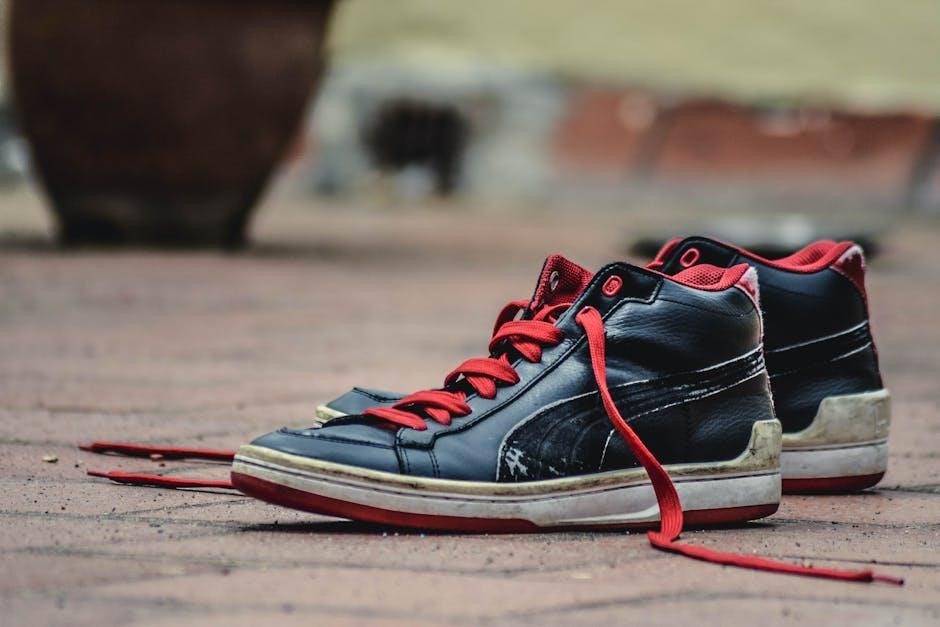
Understanding width fittings is often overlooked, yet it’s vital for optimal comfort. Australian shoes, like those in other regions, frequently offer varying widths beyond standard sizing. Common width designations include ‘B’ for narrow, ‘D’ for standard, ‘2E’ for wide, and ‘4E’ for extra wide. These fittings cater to diverse foot shapes, preventing rubbing and ensuring a secure fit.
Unlike the US, where width fittings aren’t always consistently applied, Australian retailers generally adhere to these standards. When converting sizes, consider your foot’s width alongside length. A US size 10D might translate to an Australian 10D, but if you typically require a wide fit, a 102E in Australia would be more appropriate. Always check the brand’s specific width chart, as variations exist. Ignoring width can lead to discomfort, blisters, and even foot problems, so prioritize a proper width assessment alongside length conversion.
Brand-Specific Size Variations
It’s crucial to acknowledge that shoe sizing isn’t universally standardized, even within Australia. Significant variations exist between brands due to differing manufacturing processes and last shapes – the foot-shaped form around which shoes are constructed. A size 9 in Nike might not equate to a size 9 in Adidas or a local Australian brand;
Therefore, relying solely on conversion charts can be misleading. Always consult the specific brand’s size guide, often available on their website or at the point of sale. Gucci, for example, provides detailed charts converting US sizes to their Italian/EU sizing. Some brands run smaller or larger than others, and understanding these nuances prevents incorrect purchases. Checking customer reviews can also offer valuable insights into a brand’s sizing tendencies. Prioritizing brand-specific guidance ensures a better fit and reduces the likelihood of returns or discomfort.
Measuring Your Feet for Accurate Sizing
Achieving the perfect shoe fit begins with accurately measuring your feet. This is especially important when converting between US and Australian sizes, as discrepancies can easily occur. Measure both feet, as sizes often differ slightly. Trace your foot on a piece of paper while standing, wearing socks similar to those you’d wear with the shoes.
Measure the length from heel to the longest toe in both feet, using a ruler or measuring tape. Use centimeters for the most accurate conversion. Compare your measurements to the brand’s specific size chart. Consider width as well; some brands offer width fittings. Repeat the measurement later in the day, as feet tend to swell. Accurate measurements minimize the risk of ordering the wrong size and maximize comfort.

Resources and Tools
Numerous online charts and apps simplify US to Australian shoe size conversions. Brand websites often provide detailed size guides for precise fitting information.
Online Shoe Size Conversion Charts
A plethora of websites offer convenient online shoe size conversion charts, acting as valuable resources for shoppers. These charts typically display a comprehensive table mapping US sizes to their Australian equivalents for men, women, and children. Many charts also extend to include European and UK sizes, providing a truly international conversion tool.
However, it’s crucial to remember that these charts represent general guidelines. Variations can occur between brands, and individual foot shapes play a significant role in determining the best fit. Reputable sites often include disclaimers acknowledging these potential discrepancies.
When utilizing these charts, always double-check the specific brand’s size guide if available. Some websites allow users to input their foot measurements (length and width) for a more personalized recommendation. Searching for “US to Australian shoe size chart” will yield numerous options, but prioritize those from well-established retailers or footwear authorities.
Shoe Size Conversion Apps
Several mobile applications are designed to simplify the process of converting shoe sizes, offering a convenient alternative to online charts. These apps often feature intuitive interfaces, allowing users to quickly input their US size and receive the corresponding Australian size. Many apps also incorporate foot measurement tools, utilizing the phone’s camera to estimate foot length.
Beyond basic conversions, some apps offer additional features like brand-specific size guides and the ability to save foot measurements for future reference. User reviews can provide valuable insights into the accuracy and reliability of different apps.
While these apps can be incredibly helpful, it’s essential to treat the results as estimates. Factors like sock thickness and individual foot shape can influence the ideal size; Always cross-reference the app’s recommendation with the brand’s official size chart whenever possible, ensuring a more precise fit.
Where to Find Brand-Specific Size Guides
Locating a brand’s specific size guide is crucial for accurate shoe sizing, as variations exist between manufacturers. Most brands feature detailed size charts on their official websites, often accessible through a “Size Guide” or “Fit Guide” link, typically found within the product pages or in the website’s footer.
Many retailers that carry multiple brands also provide links to the corresponding brand’s size chart on their product pages. Checking the retailer’s website, alongside the brand’s official site, offers a double-check for consistency;
Furthermore, customer service departments are valuable resources. Contacting a brand directly via phone or email can provide personalized guidance and clarify any sizing uncertainties. Utilizing these resources ensures you select the most appropriate size, minimizing returns and maximizing comfort;