
Guitar Blank Chord Chart PDF: A Comprehensive Guide
Guitar chord charts, displayed as diagrams, visually represent finger placements on the guitar neck. A PDF format offers a convenient, printable resource for musicians of all levels.
Understanding Guitar Chord Charts
Guitar chord charts, often called chord diagrams, are essential tools for guitarists. They provide a visual representation of the fretboard, specifically showing where to place your fingers to create different chords. Typically, these charts display the guitar neck vertically, with the headstock at the top and the body at the bottom.
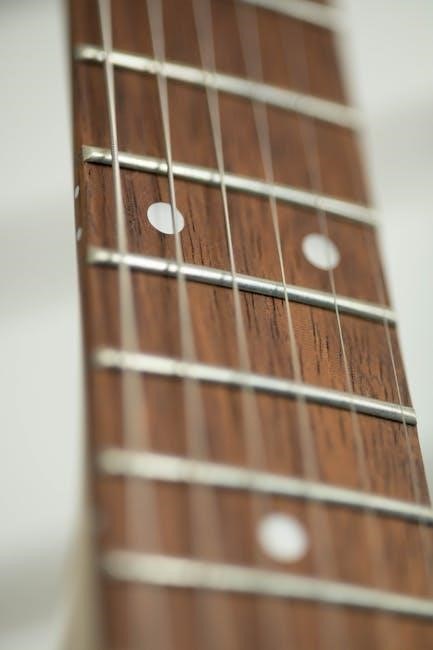
Horizontal lines represent the frets, while vertical lines symbolize the strings. Dots or numbers on the chart indicate where to press down on the strings, corresponding to specific fret and string combinations. Understanding these charts unlocks a world of musical possibilities, allowing players to quickly learn and reference chord shapes. A blank chord chart PDF empowers musicians to customize and expand their chord knowledge.
What is a Blank Chord Chart?
A blank chord chart is a pre-formatted diagram of a guitar fretboard, devoid of pre-filled chord fingerings. It’s essentially a template, usually available as a PDF, designed for guitarists to map out their own chord voicings and experiment with different finger positions. Unlike standard chord charts that show established chords, a blank version encourages personalized learning and creativity.
These charts typically feature the standard six strings and fret lines, providing a grid-like structure. Musicians can then manually add dots or symbols to indicate finger placements for various chords, inversions, or even custom tunings. It’s a valuable tool for composition, analysis, and solidifying chord memorization.
Benefits of Using a Blank Chord Chart
Utilizing a blank chord chart, often in PDF format, offers numerous advantages for guitar players. It fosters a deeper understanding of chord construction, moving beyond rote memorization to a conceptual grasp of fingerboard relationships. This active learning process enhances chord recall and improvisation skills.
Furthermore, blank charts are excellent for exploring chord variations, inversions, and custom voicings. They empower musicians to personalize their playing and develop a unique musical voice. The act of manually filling in the charts reinforces muscle memory and improves fretboard navigation. It’s a powerful tool for both beginners seeking foundational knowledge and experienced players aiming for advanced harmonic exploration.

Types of Guitar Chord Charts Available as PDFs
PDF resources offer standard chord diagrams, charts tailored for alternate guitar tunings, and specialized blank charts designed specifically for mastering barre chords.
Standard Chord Diagrams
Standard chord diagrams are the most common type found in guitar chord chart PDFs. These visually represent the guitar’s fretboard, typically showing six vertical lines for strings and horizontal lines for frets. Dots on the diagram indicate where fingers should be placed to form the chord.
These charts usually depict chords in common keys like G, C, D, Em, and Am. They are ideal for beginners learning basic chord shapes. PDF versions allow for easy printing and portability, enabling practice anywhere. Many blank chord chart templates are based on this standard format, providing a foundation for creating custom diagrams. They are a cornerstone for any guitarist’s learning journey, offering a clear and concise visual guide to chord fingerings.
Chord Boxes for Different Guitar Tunings
Chord boxes within guitar blank chord chart PDFs aren’t limited to standard tuning (EADGBE). Many charts cater to alternative tunings like Drop D, Open G, or DADGAD. These variations adjust the string pitches, requiring different fingerings for familiar chords.
PDF resources often include blank charts specifically designed for these tunings, allowing guitarists to map out new chord voicings. This is crucial for exploring different musical styles and creating unique sounds. Finding a chart tailored to your tuning simplifies the process of discovering and memorizing chord shapes. These specialized diagrams empower experimentation and broaden a guitarist’s harmonic palette, moving beyond conventional chord progressions.
Blank Charts for Barre Chords
Barre chords, essential for guitarists, require pressing one finger across multiple strings. Guitar blank chord chart PDFs often dedicate sections to these challenging forms. These charts typically display the fretboard with a pre-defined barre finger position, leaving space to map out the remaining finger placements.
Blank charts specifically for barre chords are invaluable for learning movable chord shapes. They allow musicians to visualize and experiment with different voicings across the neck. A good PDF resource will offer various barre chord templates, catering to major, minor, and seventh chords. Mastering barre chords expands harmonic possibilities and unlocks a wider range of musical expression, making these charts a vital practice tool.
Creating Your Own Guitar Chord Charts
Custom chord charts empower guitarists to document unique voicings and techniques. PDF creation allows for easy sharing and preservation of personalized guitar chord diagrams.
Tools for Creating Charts (Software & Online)
Several digital tools simplify the process of crafting guitar chord charts in PDF format. Dedicated music notation software, like Dorico Pro, offers robust features for detailed chart creation, though a learning curve exists. Alternatively, numerous online chord chart generators provide user-friendly interfaces, often with pre-built templates and customizable options.
These online tools typically allow users to visually construct chord diagrams by clicking on fretboard positions. Some even incorporate features for adding finger placement indicators and chord names directly onto the chart. The resulting charts can then be downloaded as PDF files for printing or digital storage. While software provides greater control, online generators offer accessibility and speed, making them ideal for quick chart creation.
Exploring both software and online options will help you find the best fit for your needs and skill level when designing your guitar chord charts.
Hand-Drawing Chord Diagrams
Despite the availability of digital tools, hand-drawing chord diagrams remains a viable method for creating guitar chord charts, especially for those preferring a tactile approach. This method requires a basic understanding of chord structure and fretboard layout. Start with a template representing the guitar neck, clearly marking the fret numbers and strings.
Using a pencil and eraser allows for easy corrections. Accurately depict finger placement indicators, representing each finger with a number or symbol. Ensure the diagrams are neat and legible, as clarity is crucial for understanding the chord. While less precise than software, hand-drawing fosters a deeper connection with the music and allows for personalized chart designs.
Once completed, these charts can be scanned or photographed to create a digital PDF copy for convenient storage and sharing.
Labeling Chord Charts with Finger Positions
Accurate labeling of finger positions is paramount for effective guitar chord charts. A standard convention utilizes numbers to represent each finger: 1 for the index, 2 for the middle, 3 for the ring, and 4 for the pinky. These numbers are placed directly on the dots indicating where each finger should press down on the fretboard.
Consistency is key; always use the same numbering system throughout all your charts. Some charts also include “X” above strings that shouldn’t be played and “O” for open strings. Clear finger placement indicators minimize ambiguity and ensure players can quickly and accurately form the chord.
Properly labeled PDF charts are invaluable tools for learning and teaching, promoting efficient practice and understanding of guitar technique.

Essential Chord Chart Elements
Chord charts fundamentally require fret numbers and string representation. Finger placement indicators and clearly displayed chord names are also crucial for readability.
Fret Numbers and Strings
Fret numbers on a guitar chord chart are typically displayed vertically along the left side of the diagram, indicating which fret to press down on. These numbers correspond to the metal bars running across the guitar neck. The strings are represented by horizontal lines, with the thickest string (low E) usually at the bottom and the thinnest (high E) at the top.

A blank chord chart PDF will have these lines pre-drawn, allowing you to fill in the finger positions. Understanding this basic layout is essential for interpreting and creating your own chord diagrams. Accurate representation of both fret numbers and strings ensures correct chord formation and clear communication between guitarists. Consistent formatting aids in quick recognition and efficient learning.
Finger Placement Indicators
Finger placement indicators on a guitar blank chord chart PDF are crucial for understanding how to form each chord. These are typically represented by numbered circles or symbols placed on the strings and frets. Each number corresponds to a specific finger: 1 for the index, 2 for the middle, 3 for the ring, and 4 for the pinky.
A blank chart allows you to manually add these indicators as you learn or create chords. Correctly placing these symbols is vital for accurate finger positioning and clean sound. Some charts may also use ‘X’ to denote strings that should not be played, and ‘O’ for open strings. Mastering these indicators unlocks the ability to decipher and utilize any chord diagram effectively.
Chord Names and Variations
Chord names are essential components of any guitar blank chord chart PDF, providing immediate identification of the chord being represented. Standard notation includes the root note followed by the chord type – for example, “C Major,” “G minor,” or “F7.”
Beyond basic chords, charts often display variations like add9, sus4, or diminished chords. A blank chart empowers you to label these yourself, expanding your harmonic vocabulary. Clearly written chord names facilitate quick reference during practice or performance. Understanding these names and their corresponding fingerings is fundamental to musical expression and improvisation on the guitar.

Advanced Chord Chart Features
Advanced charts integrate note names and interval information, enhancing theoretical understanding. Exploring chord inversions and diverse voicings unlocks harmonic richness for guitarists.
Including Note Names on Charts
Integrating note names directly onto guitar chord charts elevates them beyond simple finger placement guides. This feature is invaluable for musicians seeking a deeper comprehension of music theory and the harmonic structure of chords. Rather than merely memorizing shapes, players can actively identify the individual notes comprising each chord, fostering a stronger connection between their fingers and the underlying musical concepts.
Detailed charts displaying note names empower guitarists to understand how chords are built, facilitating improvisation and composition. It allows for quicker transposition to different keys and a more intuitive grasp of chord substitutions. This approach is particularly beneficial for those learning to navigate the fretboard and build a robust understanding of musical relationships. Ultimately, note-labeled charts transform a practical tool into an educational resource.
Adding Interval Information
Supplementing guitar chord charts with interval information provides a profound theoretical understanding beyond just the chord shape. Intervals – the distance between notes – are fundamental to harmony and music construction. Displaying these intervals (major third, perfect fifth, etc.) on a chart unlocks a deeper comprehension of why a chord sounds the way it does, not just how to play it.
This detailed approach empowers guitarists to analyze chord voicings, understand chord progressions, and even create their own unique chord variations. It bridges the gap between rote memorization and genuine musical insight. Interval-labeled charts are especially useful for composing, arranging, and improvising, allowing musicians to confidently navigate the fretboard and explore harmonic possibilities.
Chord Inversions and Voicings
Guitar chord charts often depict only the most common voicing of a chord. However, exploring chord inversions and alternative voicings dramatically expands harmonic color and musical expression. An inversion alters which note is the lowest in the chord, creating subtle but significant tonal shifts. Different voicings rearrange the notes within the chord, offering varied textures.
Blank chord charts become invaluable tools for experimenting with these concepts. By manually notating inversions and voicings, guitarists can visualize how these changes affect the overall sound. This practice fosters a deeper understanding of harmony and allows for more nuanced and creative chord progressions. Mastering inversions unlocks smoother transitions and richer arrangements.

Guitar Techniques and Chord Charts
Chord charts can integrate techniques like hammer-ons and pull-offs, visually indicating these maneuvers. Slide guitar notation, using slurs, enhances chart clarity for advanced players.
Hammer-ons and Pull-offs on Chord Charts
Hammer-ons and pull-offs are essential guitar techniques for creating fluid and expressive melodies. Representing these on chord charts requires specific notation. Typically, a curved line connects the initial fretted note to the hammered-on or pulled-off note. This visually indicates the technique without needing to fully fret the second note initially.
When creating your own blank chord charts, dedicate space to clearly mark these techniques. Consider using different line styles (dotted or dashed) to differentiate between hammer-ons and pull-offs. Accurate placement of these curved lines is crucial for understanding the intended execution. Some charts may also include small “h” for hammer-on and “p” for pull-off near the notation for added clarity. Mastering this notation allows for precise interpretation of guitar arrangements.
Slide Guitar Techniques & Chart Notation
Slide guitar techniques, involving smoothly gliding a slide along the strings, demand unique notation on chord charts. A common method utilizes a forward slash (/) to indicate a slide up to a higher fret, and a backslash for a slide down to a lower fret. These slashes are placed between the starting and ending fret numbers on the relevant string.
When designing blank chord charts for slide guitar, ensure sufficient space to clearly depict these slashes. Some charts also employ arrows to visually represent the direction of the slide. For complex slides spanning multiple strings, consider using a combination of slashes and arrows for enhanced clarity. Accurate notation is vital for conveying the nuances of slide guitar playing, allowing musicians to replicate the intended sound effectively.
Using Chord Charts with Tablature (Future Integration)
Currently, a seamless integration of chord charts and guitar tablature within a single PDF remains a developing area. While not universally standard, combining these formats offers a powerful learning tool. Tablature excels at showing where to place fingers, while chord diagrams illustrate the overall chord shape and harmonic context.
Future PDF designs could layer tablature directly beneath the chord chart, providing both fretboard positions and chord names simultaneously. This hybrid approach caters to diverse learning styles. The ability to easily switch between chord and tab views within a single document would significantly enhance practice efficiency. Expect to see increased demand for this integrated format as digital music resources evolve.

Resources for Guitar Chord Charts (PDF Downloads)
Free printable charts and commercial PDFs are readily available online. Chord chart generators offer customizable options, catering to various skill levels and musical needs.
Free Printable Blank Chord Charts
Numerous websites offer free downloadable PDF versions of blank guitar chord charts. These are incredibly valuable resources, especially for beginner guitarists learning fundamental chord shapes and finger positions. They provide a template to practice writing in chord names and experimenting with different voicings;
These charts typically display a representation of the guitar fretboard, allowing users to visually map out chord fingerings. Many options cater to different preferences, including charts with varying levels of detail and complexity. You can find basic charts focusing on common major and minor chords, as well as more advanced charts designed for barre chords and complex harmonies.
A quick online search for “free blank guitar chord chart PDF” will yield a wealth of options. These resources are perfect for creating a personalized chord library or for use in guitar lessons.
Commercial Chord Chart PDFs
While many free blank chord chart PDFs are available, commercial options often provide a more comprehensive and professionally designed experience. These paid resources frequently include a wider variety of chord diagrams, encompassing advanced chord voicings, chord inversions, and charts tailored to specific musical genres.
Commercial PDFs may also feature additional elements like note names directly on the diagrams, interval information, and detailed explanations of guitar techniques. Some even offer charts specifically designed for different guitar tunings beyond standard tuning. The quality of the printing and the clarity of the diagrams are generally higher in paid versions.
These charts are a good investment for serious guitarists seeking a detailed and organized resource to expand their harmonic knowledge and improve their playing. They can be found on music retail websites and specialized guitar instruction platforms.
Online Chord Chart Generators
Online chord chart generators offer a dynamic alternative to static PDF downloads. These web-based tools allow users to create custom chord diagrams directly within their browser, often with interactive features. You can typically select the chord type, root note, and even specify fingerings to generate a personalized chart.
Many generators provide options to adjust the display, such as showing note names or interval information. Some allow you to download the created chart as a PDF for offline use or printing. This is incredibly useful for quickly visualizing chords or creating charts for songs you’re learning.

These tools are excellent for experimentation and learning, offering a flexible way to explore different chord voicings and fingerings. Several websites offer these services, ranging from simple generators to more feature-rich applications.